

Feature Request Tools: Capture, Track and Vote in Discord
A feature request tool collects, organizes and tracks product ideas in one place. It merges duplicates, counts votes and shows each idea's status, so you can stop relying on spreadsheets and memory. RoadmapAI does this inside your Discord server. Its AI reads chat by context and intent, captures requests, and publishes only owner-approved items to a public roadmap.
You have probably lived the alternative. Someone asks for dark mode in #general on Monday. Three more people ask for it in different words on Wednesday. By Friday the thread has scrolled away, and you are guessing what your community wants. Let's fix that.
What feature request software should do
Before you pick any feature request software, hold it to a short checklist. A good feature request tracking tool does five things:
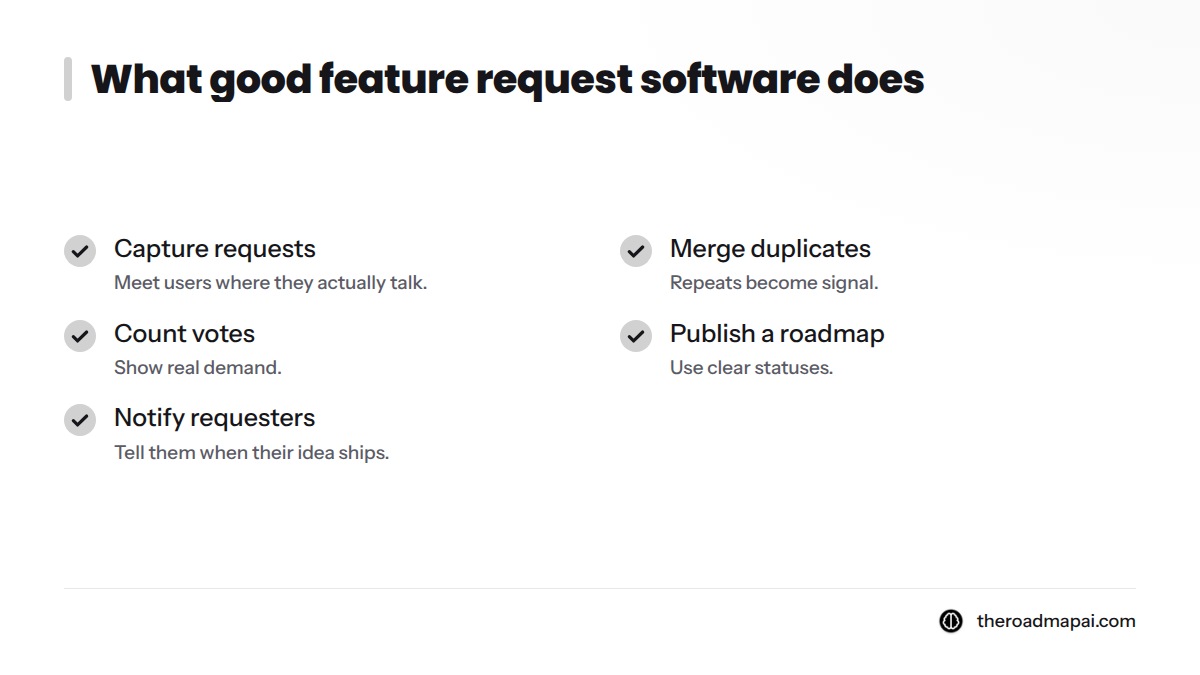
- Capture requests where users actually talk.
- Merge duplicates so repeats become signal.
- Count votes and show real demand.
- Publish a roadmap with clear statuses.
- Notify requesters when their idea ships.
A spreadsheet does none of this on its own. It holds rows, but it cannot read a chat, notice that two messages mean the same thing, or tell a requester you shipped their idea. Memory fails faster still. Here is what each item on the list looks like in practice.
Capture requests where users actually talk
Most tools assume users will visit a web portal and fill in a form. Many will not. In a community, ideas show up mid-conversation, in the channel where people already hang out. A tool to collect feature requests has to meet users there, or the best feedback never reaches your backlog.
Merge duplicates so repeats become signal
Ten people asking for the same thing in ten ways is not ten problems. It is one strong signal. Without duplicate merging, you see ten small items and none of them looks urgent.
Count votes and show demand
Feature voting turns opinions into a ranking you can defend. When demand is visible, you stop arguing from gut feeling and start building what people ask for most.
Publish a roadmap with clear statuses
A public roadmap tells users what you are considering, building and have shipped. Labels such as Under Consideration, In Development and Shipped keep expectations honest.
Tell requesters when it ships
Most teams skip this step, and it costs them. People who hear back keep contributing. People who don't hear back stop. Closing the feedback loop is what turns a one-time request into a lasting relationship.
How RoadmapAI handles feature requests in Discord communities
RoadmapAI works in three stages: Detect, Merge, Publish.
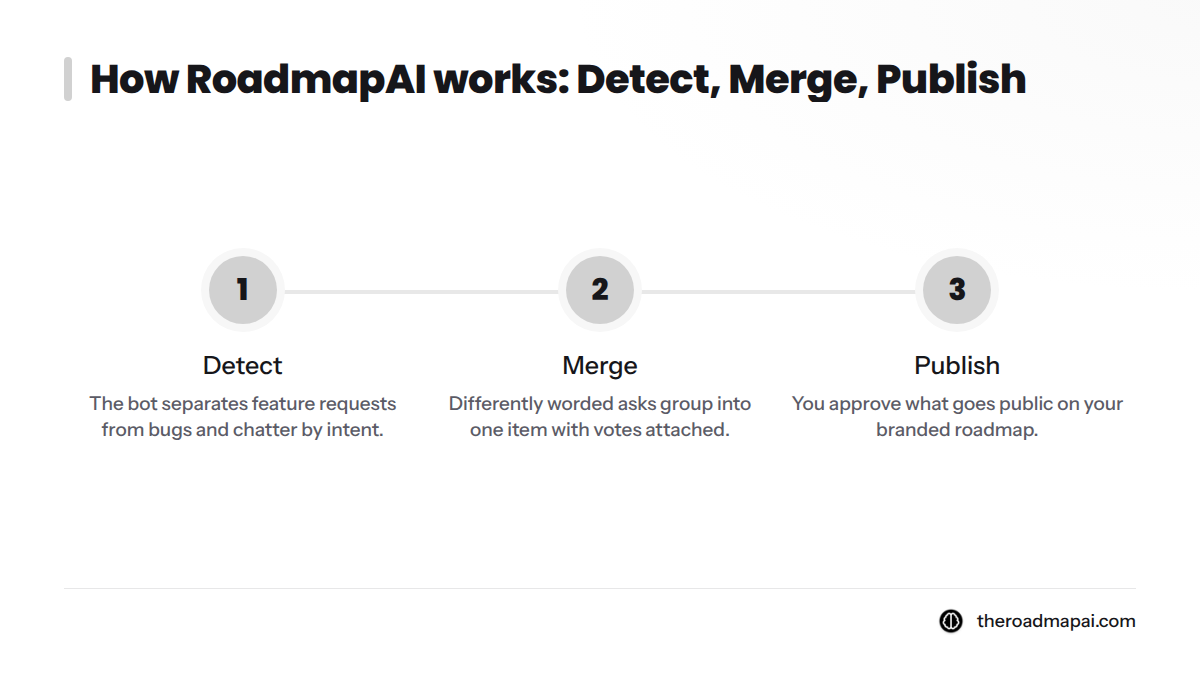
- Detect: The bot reads messages in your server and separates real feature requests from bug reports and general chatter. It works on intent, not keyword matching, so "it would be great if I could export this" counts even though it never says "feature request."
- Merge: Differently worded asks for the same thing group into one tracked item, with each person's vote attached.
- Publish: You approve what goes public, and approved items appear on your branded roadmap.
The bot also replies in-thread, so the person who asked knows their idea was seen. If you want the mechanics of chat capture, see the Discord feedback bot page on this site.
Ready to see it on your own server? Start the 7-day free trial and add the bot to your Discord server.
From raw chat to tracked request
The clearest way to understand a Discord feature request bot is to watch a message travel through it. Every example follows the same four-step path:
| Step | What happens |
|---|---|
| Original message | A member writes a casual line in a channel, with no form and no command. |
| Classification | The AI labels it as a feature request, a bug or chatter, and attaches a detection confidence. |
| Tracked item | A request is created, or the message joins an existing one as another vote. |
| Owner review | You decide whether it stays private, gets edited or goes on the roadmap. |
Real captured messages, with their actual confidence scores, live on the roadmap and in the product dashboard. I would rather point you there than invent illustrative numbers here, because made-up scores would defeat the point of showing proof.
Detection confidence: how sure the AI is
Detection confidence is a score showing how sure the AI is that a message is a feature request. A high score means the message reads clearly as a request. A lower score means the wording was ambiguous, such as a question that might be a complaint.
Treat the score as a triage aid. High-confidence items are quick approvals. Lower-confidence items deserve a second look before you act on them.
Nothing goes public until you approve it. The AI captures and organizes. You decide what your community sees.
That owner control matters. An AI that publishes on its own can put half-formed ideas or off-topic chatter in front of your users. RoadmapAI keeps you in charge.
Duplicate merging and voting: turning repeats into signal
Picture three messages from three members: "Can we get a dark theme?", "my eyes hurt at night, any night mode?" and "please add dark mode." Different words, same ask. A good customer feature request tool merges them into one item with three votes instead of leaving three weak requests that nobody prioritizes.
That is the whole idea behind duplicate merging paired with feature voting. Demand stacks up where you can see it, and the most-wanted items rise on their own. The dedicated feature pages go deeper on voting and merging, tool by tool.
Roadmap and ship notices: closing the loop
Once you approve an item, it can appear on a public roadmap that carries your logo, your colors and your custom domain. It looks like your product, not ours.
When you ship, requesters get notified, and the bot acknowledges requests in-thread along the way. Pair that with a changelog and users get a running record of what changed. To compare options, see these changelog options for shipping updates. Public feedback boards also give members a place to browse and vote on ideas without scrolling through chat history.
The live RoadmapAI roadmap as proof
We run our own product on RoadmapAI. The live roadmap is the working end state of everything above: requests that came from real conversations, grouped by status, with shipped items visible next to planned ones. Open it and you see the same view your users would see. Claims are easy to make. A roadmap you can click through is harder to fake.
Who RoadmapAI fits, and who it doesn't
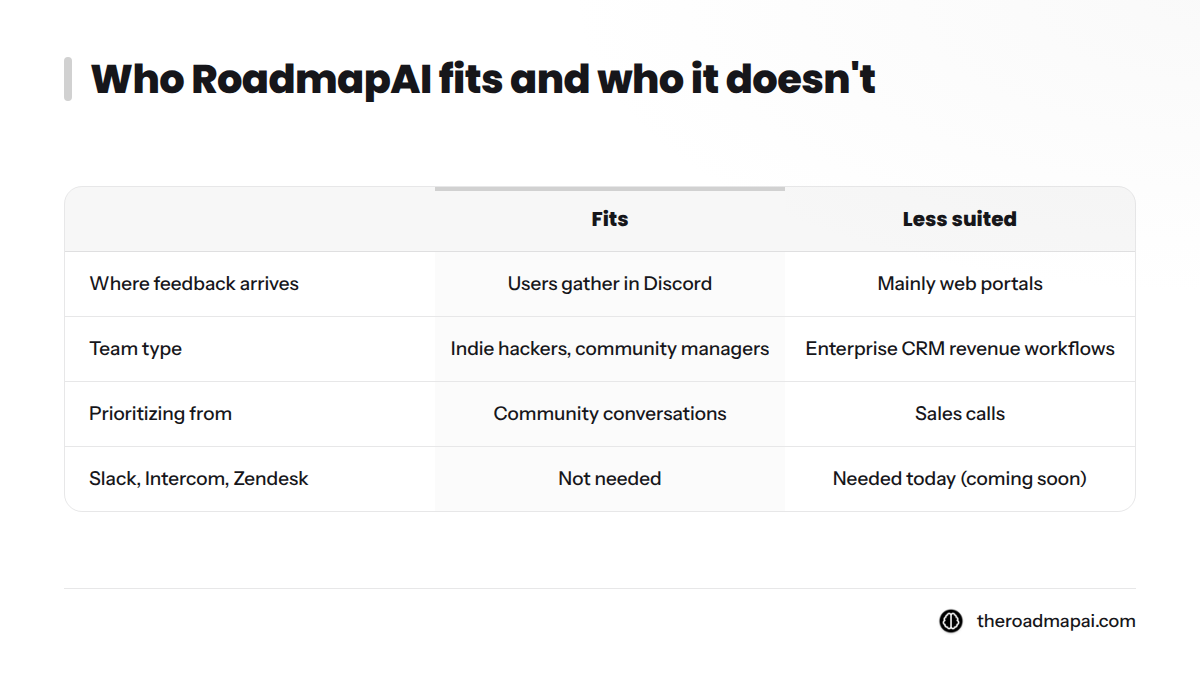
Honest fit saves you a wasted trial.
| Fits | Less suited |
|---|---|
| Indie hackers whose users gather in Discord | Teams whose feedback arrives mainly through web portals |
| Discord community managers | Teams prioritizing from sales calls |
| Community-driven SaaS teams | Enterprise CRM revenue workflows |
| Side-project founders who need something lightweight | Teams that need Slack, Intercom or Zendesk today (these are coming soon) |
| Teams switching from Canny or Upvoty because users live in Discord |
This is a design difference, not a criticism of other tools. If you are hunting for a Canny alternative, the question is where your users talk. Discord-native capture starts from a different place than tools built around web-only boards.
Next steps: try it, compare tools or migrate
You have three sensible paths:
- Try it: check RoadmapAI pricing and start the 7-day free trial. A one-time Lifetime plan with bring-your-own-key is also available, so you can connect your own Anthropic API key. The pricing page has the details.
- Compare: read our buyer's guide to feature request tools for a side-by-side view.
- Migrate: if you run a board on Canny today, see how to migrate from Canny.
Start the 7-day free trial and add the bot to your Discord server.
Frequently asked questions
What is a feature request tool?
A feature request tool collects product ideas from users in one place, merges duplicates, counts votes and shows each idea's status. It replaces scattered chat threads and spreadsheets with a single ranked list your team can act on. Some vendors label this category feature request management software.
How is RoadmapAI different from Canny or Upvoty?
RoadmapAI captures requests directly from Discord conversations using AI that reads intent. Canny describes its own approach on its feature request page, so check it there for current details. Tools built around web boards expect users to visit a portal. RoadmapAI starts in the chat.
Does anything go public automatically?
No. The AI captures and organizes requests, but nothing appears on your public roadmap until you approve it.
Can I try it before paying?
Yes. RoadmapAI offers a 7-day free trial, and the pricing page lists the current plans.