 RoadmapAI
Best AI Feedback Tools for Product Teams in 2026
Compare the best AI feedback tools for product teams: RoadmapAI, Canny, Featurebase, Frill and Productboard, judged on six clear criteria.
The best AI feedback tools for product teams in 2026 are RoadmapAI for Discord-first communities, Canny, Featurebase and Frill for portal-first SaaS teams, and Productboard for research-heavy product orgs. RoadmapAI publishes this guide and lists itself first, so the selection criteria are spelled out below. Last reviewed: October 2026. In this guide, "AI feedback" means tools that capture and organize product and community feedback. It does not mean writing feedback for students or model-training loops.
I hear the same complaint from nearly every product team I talk to. Feature requests arrive in chat threads, support tickets and half-remembered calls. Someone tags them by hand, duplicates split the votes, and the one request that matters sinks under bug reports and banter. Let's break down which tools fix that, and for whom.
Which AI Feedback Tools Are Worth Shortlisting in 2026
Start with where your users already talk. That one question usually cuts five good options down to one or two.
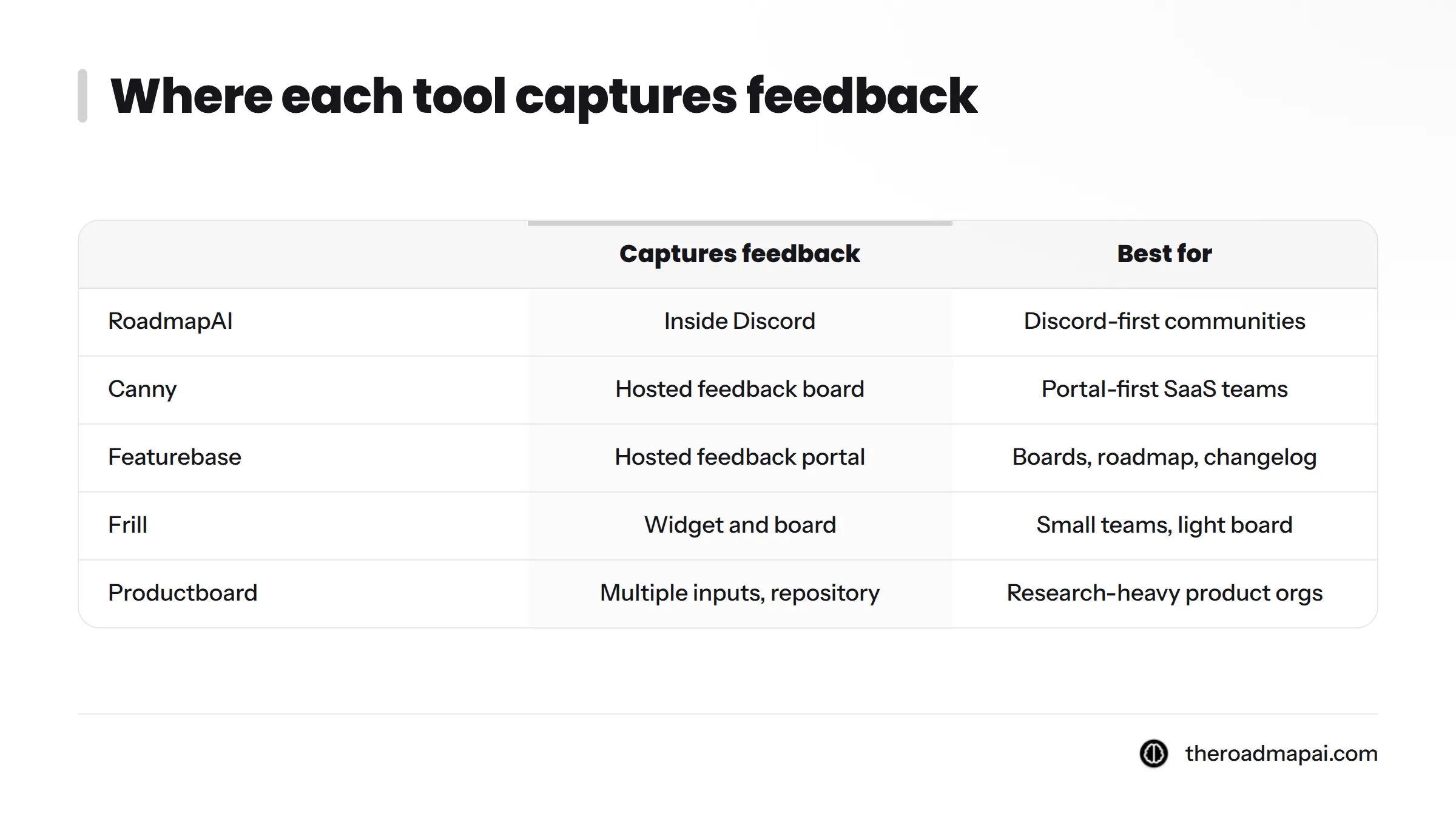
| Tool | Where it captures feedback | Best for |
|---|---|---|
| RoadmapAI | Inside Discord conversations | Discord-first communities and indie teams |
| Canny | A hosted feedback board | Portal-first SaaS teams |
| Featurebase | A hosted feedback portal | Teams wanting boards, roadmap and changelog together |
| Frill | A hosted feedback widget and board | Small teams wanting a lightweight board |
| Productboard | Multiple inputs into a research repository | Research-heavy, prioritization-focused product orgs |
What are AI feedback tools? They use language models to collect product feedback, separate feature requests from bugs and chatter, group similar asks, and pull out themes. Product teams spend less time reading and labeling every message, and more time deciding what to build. Think of them as AI product feedback software for the intake stage of your workflow.
If Discord is your main channel, an AI feature request tool built for Discord removes the step where users have to go somewhere else.
How I Chose These AI Product Feedback Tools
I used six criteria and applied them the same way to every entry. Capability claims about other vendors come from each vendor's own public pages. Anything I say about RoadmapAI's behavior is first-hand observation, and I label it that way.
Where feedback is collected
Feedback lives in chat, portals, support inboxes and surveys. A tool that captures in one place misses the rest. Ask which channel carries most of your volume, because that is where feature request capture has to work.
Intent classification vs keyword matching
Keyword matching flags the word "feature" and misses "it would be great if exports included dates." Intent classification reads the message in context and decides whether it is a request, a bug report or chatter. That difference sets how much noise reaches your backlog.
Duplicate merging and voting boards
Differently worded asks should become votes on one item. A voting board only reflects demand when duplicate merging works, because split votes hide what people want.
Human approval before anything goes public
AI will misread some messages. A review step before publishing keeps a wrong guess off your public roadmap.
Integrations, MCP and bring-your-own-key (BYOK)
The Model Context Protocol is an open standard from Anthropic for connecting AI assistants to external tools and data. Bring-your-own-key means you plug in your own model provider account instead of paying a markup on usage.
How I sourced claims
Capability claims about other vendors link to their own sites. Where I could not verify a capability, I left it out. I give no competitor pricing, accuracy percentages or adoption figures.
What should you look for in AI feedback management?
- Capture where your users already talk.
- Intent classification, not keyword rules.
- Duplicate merging that turns repeats into votes.
- An approval step before items go public.
- Integrations, MCP access and key flexibility.
- A way to notify users when a request ships.
1. RoadmapAI: Discord-Native Intent Detection for Feature Requests
Best for: Discord-first communities, indie hackers and small product teams.
RoadmapAI is an AI agent that sits in your Discord server. It reads conversations, decides whether a message is a feature request, a bug or chatter, and turns real requests into items on a board. Its feature request tools let members capture, track and vote without leaving chat. Among AI powered feature request tools, it is the one built around Discord-native intent detection.
Here is what I see in RoadmapAI's own behavior:
- Classification: it separates requests from bugs and casual talk using the conversation, not a keyword list.
- Merging: three people might write "dark mode please," "can we get a night theme," and "my eyes hurt at night, any theme options?" They land as one item with three votes.
- Approval gate: nothing goes public until you approve it.
- Publishing and replies: approved items appear on a public roadmap. The bot replies in-thread, and changelog notifications go out when something ships.
- MCP server: assistants can list, add and mark items as shipped.
- BYOK: the Lifetime plan lets you bring your own Claude key.
Honest limits: Slack, Intercom and Zendesk support are listed as coming soon. RoadmapAI fits best where Discord is the main channel. The Discord feedback bot page has the details.
2. Canny: Portal-Based Feedback Board
Best for: SaaS teams that already send users to a feedback board.
Canny is a long-standing hosted board where users submit and vote on ideas, with roadmap and changelog views. Its strength is a familiar pattern that customers already understand, backed by a mature board workflow. The trade-off: users must visit the portal, so feedback shared in chat or support threads has to be moved over by hand. Check Canny's site for its current AI features before you commit.
3. Featurebase: Boards and Changelog in One Product
Best for: teams that want feedback, roadmap and changelog in one hosted product.
Featurebase bundles a feedback board, roadmap and changelog, so the full request-to-release loop lives in one place. The trade-off is the same as with any portal: getting users to the portal remains your job. Confirm AI capabilities on Featurebase's own pages.
4. Frill: A Lightweight Board for Small Teams
Best for: small teams that want a simple hosted board and widget.
Frill offers a feedback board, roadmap and announcements in a compact package. It suits teams that do not need a heavy research workflow. It is portal-based, so it depends on users coming to the board. Review Frill's site for current AI functionality.
5. Productboard: Research Repository and Prioritization
Best for: larger product organizations that synthesize feedback from many sources.
Productboard collects customer input into a central repository and ties it to prioritization and roadmaps. It suits teams doing structured research and weighing many inputs at once. The trade-off: it is built for process-heavy organizations, which can be more than a small community team needs. Check Productboard's pages for its current AI features.
For brand head-to-heads and a wider field, see the broader feature request tools guide.
Discord-Native Intent Detection vs Portal-Based Feedback Tools
The structural difference is who has to change behavior. A portal asks your users to leave their conversation. A chat-native agent meets them where they already are.
| Factor | Discord-native intent detection | Portal-based feedback tools |
|---|---|---|
| Capture location | Inside the chat conversation | A separate hosted board |
| Who changes behavior | The tool adapts | The user visits the portal |
| Classification input | Conversation context | A submitted form or post |
| Duplicate handling | Merges differently worded asks | Typically suggests or merges on submission |
| Approval and publishing | Human approval, then public roadmap | Moderation, then board |
| Best fit | Discord-centered communities | Portal-first SaaS products |
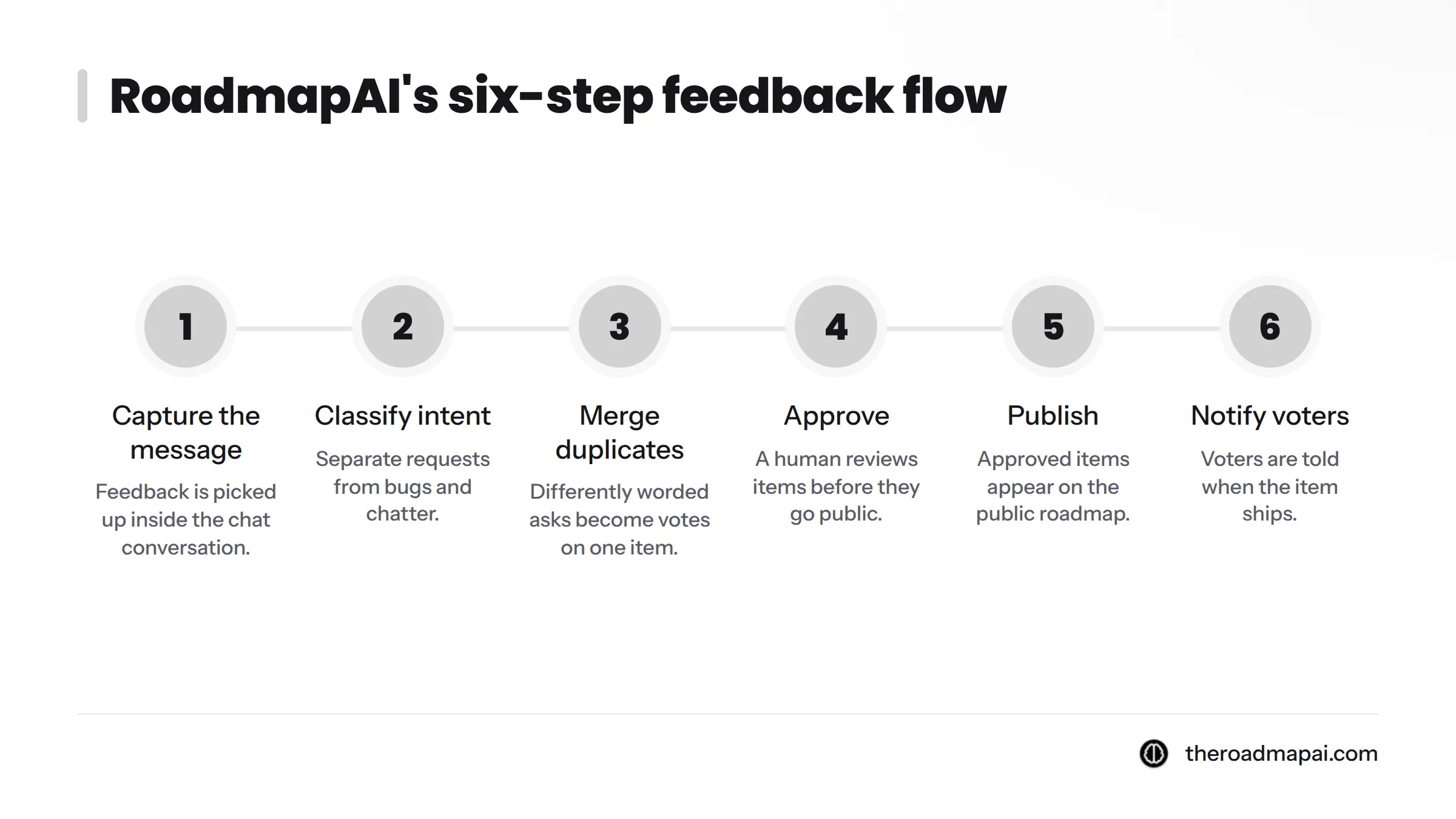
RoadmapAI's flow runs in six steps: capture the message, classify intent, merge duplicates, approve, publish, then notify voters when the item ships. Each of those steps is a place where a portal tool asks the user or the team to do manual work.
Once feedback is captured, you still have to analyze it. That is a separate skill, and a guide on running AI feedback analysis is the right next step.
Which Tool Fits Which Product Team
No single tool is best for every team. Match the tool to the channel.
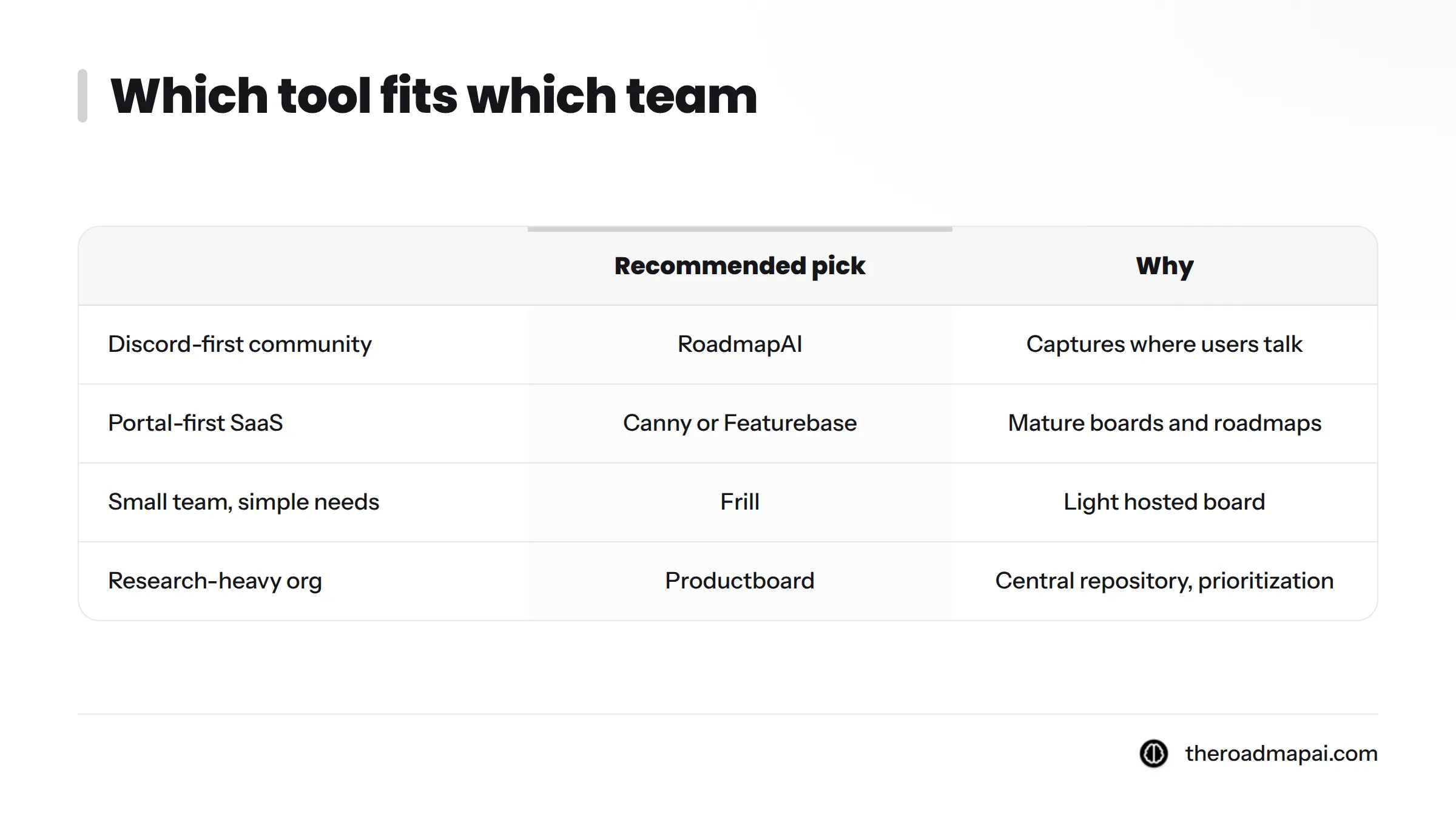
| Team type | Recommended pick | Why |
|---|---|---|
| Discord-first community | RoadmapAI | Captures where users already talk |
| Portal-first SaaS | Canny or Featurebase | Mature boards and roadmaps |
| Small team, simple needs | Frill | Light hosted board |
| Research-heavy product org | Productboard | Central repository and prioritization |
If your community lives in Discord, RoadmapAI is my recommendation, and you can test it free for seven days. See RoadmapAI plans and free trial. If your users already live in a portal, choose a portal tool and skip the switch.
Frequently Asked Questions
What is an AI feedback tool?
It is software that uses language models to collect product feedback, sort feature requests from bugs and chatter, group similar asks and surface themes. Teams spend less time on manual tagging.
What should I look for in an AI feedback tool?
Look for capture in your users' channel, intent classification, duplicate merging, an approval step, integrations such as MCP, and a way to notify users when requests ship.
How does an AI feedback tool tell a feature request from a bug?
It reads the message in context. A request describes something users want added or changed. A bug report describes something that should work but does not. Chatter is neither. Classification is not perfect, which is why an approval step matters.
What is the difference between intent detection and keyword matching?
Keyword matching looks for fixed words. Intent detection interprets meaning, so it catches requests phrased in unusual ways and ignores messages that contain the right word by accident.
Do my users need to visit a separate portal?
With portal-based tools, yes. With a Discord-native tool, users keep talking in chat and the agent captures requests from the conversation.
Can AI publish requests to my roadmap automatically?
In RoadmapAI, no. You approve items before anything goes public.
What does MCP integration let me do?
With RoadmapAI's MCP server, a connected AI assistant can list items, add items and mark them shipped. You can manage the board from your assistant.